
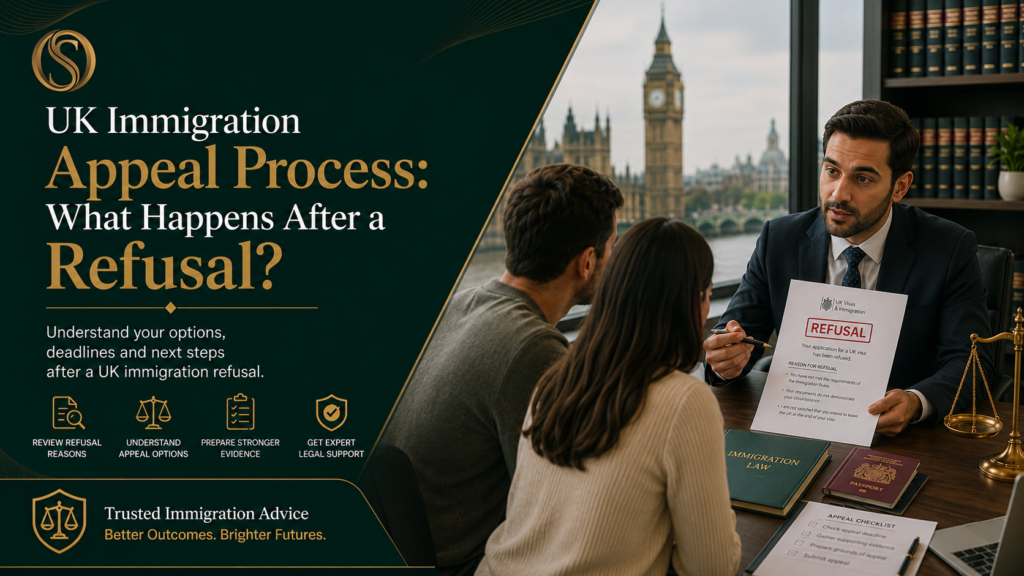
Receiving a UK visa or immigration refusal can feel overwhelming. For many people, the refusal letter is not just a document. It may affect family life, work, study, safety, future plans and the right to remain in the UK. If you have been refused, it is normal to feel confused, worried or unsure about what to do next.
The important thing to understand is this: a refusal is not always the end of the road.
Depending on the type of application, the reasons for refusal and the rights given in your decision letter, you may be able to challenge the decision through a UK immigration appeal, administrative review, reconsideration request or, in some cases, judicial review. The correct route depends on your circumstances, and choosing the wrong option can waste valuable time.
This guide explains the UK immigration appeal process in clear language. It covers what happens after a refusal, how to check whether you have a right of appeal, what evidence may be needed, what happens at the tribunal and when it may be helpful to speak with an experienced immigration appeal solicitor.
If you need tailored advice about a refusal, OS Law Solicitors can review your decision letter and advise you on the next steps. You can learn more about our immigration services here: Immigration Solicitors.
Quick Answer: What Happens After a UK Immigration Refusal?
After a UK immigration refusal, you should carefully read the refusal letter to see whether you have a right to appeal, a right to administrative review or another possible challenge. If you have a right of appeal, you normally need to submit your appeal within the deadline stated in the decision letter. The appeal is usually made to the First-tier Tribunal Immigration and Asylum Chamber, where an independent judge considers whether the Home Office or UKVI decision was legally wrong.
The process usually includes:
- Receiving the refusal decision
- Checking whether you have appeal rights
- Reviewing the refusal reasons
- Preparing grounds of appeal
- Submitting the appeal within the deadline
- Gathering supporting evidence
- Preparing witness statements and legal arguments
- Attending a tribunal hearing, if required
- Receiving the tribunal decision
- Waiting for Home Office action if the appeal is allowed
Not every refusal has a right of appeal. Some refusals only allow administrative review. Some may require a fresh application instead. This is why the refusal letter is the starting point.
What Is a UK Immigration Appeal?
A UK immigration appeal is a legal challenge against a visa or immigration decision. It asks an independent tribunal to look at the decision and decide whether it should stand.
In simple terms, an appeal allows you to say:
“The Home Office decision is wrong, and here is the legal and factual reason why.”
An immigration appeal is not the same as simply asking the Home Office to look again. It is a formal process before the Immigration and Asylum Chamber. The tribunal can consider the decision, the evidence and the legal arguments. In some appeals, the judge may also hear from the applicant, sponsor, family members or other witnesses.
People often search for an immigration appeal solicitor after receiving a refusal because the process can be technical. A strong appeal is not just about saying the decision is unfair. It must explain why the refusal is wrong under immigration law, human rights law, asylum law or the relevant rules.
Common Types of Immigration Decisions That May Be Appealed
Not every immigration refusal gives a right of appeal. However, appeal rights may arise in certain categories, especially where human rights, protection or specific legal rights are involved.
Common examples may include:
- Human rights claims
- Family visa refusals involving Article 8 family or private life rights
- Refusals involving spouse, partner, parent or child applications
- Protection and asylum refusals
- Some EU Settlement Scheme decisions
- Revocation of protection status
- Deprivation of citizenship decisions in certain cases
- Refusals where the decision letter specifically confirms a right of appeal
In many visa categories, especially points-based system applications, the refusal may not give a right of appeal. Instead, the applicant may be offered administrative review. This is common where the issue is whether UKVI made a caseworking error.
The safest approach is to check the exact wording of your refusal letter. It should explain whether you can appeal immigration decision, request administrative review or take another step.
Appeal, Administrative Review or Fresh Application: What Is the Difference?
After a refusal, many people are unsure whether they should appeal, request administrative review or apply again. These are different routes.
Immigration Appeal
An immigration appeal is usually heard by an independent tribunal. It may involve legal arguments, evidence, witness statements and a hearing. It is often used where the refusal affects human rights, protection rights or other appealable rights.
Administrative Review
Administrative review is an internal review by the Home Office or UKVI. It is normally used where you believe the decision contains a caseworking error. It is not usually a full reconsideration of all facts in the same way as an appeal.
For example, administrative review may be relevant where UKVI overlooked a document, applied the wrong rule or made an obvious factual mistake.
Fresh Application
A fresh application means submitting a new visa or immigration application. This may be the better route if the refusal happened because important documents were missing, financial evidence was incomplete or circumstances have changed.
A fresh application may be faster or more practical in some cases, but it also means paying a new application fee and possibly the Immigration Health Surcharge again, depending on the visa type.
Judicial Review
Judicial review is a legal challenge to the lawfulness of a decision or process. It is usually considered where there is no right of appeal or administrative review, or where the Home Office has acted unlawfully. Judicial review is complex and should be considered carefully with legal advice.
Step 1: Read the Refusal Letter Carefully
The refusal letter is the most important document after a UK immigration refusal. Before doing anything else, read it slowly and check the following:
- What application was refused
- The date of the decision
- The reasons for refusal
- The immigration rules relied on
- Whether the decision gives a right of appeal
- Whether the decision gives a right to administrative review
- The deadline for taking action
- Whether the appeal is in-country or out-of-country
- Whether removal or departure is mentioned
- Whether human rights or protection issues were considered
Many people focus only on the final refusal outcome and miss the details. However, the reasons for refusal tell you what must be challenged. For example, the refusal may say the Home Office was not satisfied about income, relationship evidence, accommodation, credibility, English language, dependency, genuineness or suitability.
A strong appeal starts with identifying the exact refusal points and responding to each one with evidence and legal arguments.
Step 2: Check Whether You Have a Right of Appeal
The next step is to confirm whether you actually have appeal rights. This should normally be stated in the decision letter.
If you have a right of appeal, the letter should explain how to appeal and the deadline. If you do not have appeal rights, it may say that you can request administrative review or that there is no right of appeal.
Appeal rights can depend on the type of claim. For example, some human rights and protection decisions may carry appeal rights, while some work, student or visitor visa refusals may not.
This is where many applicants make mistakes. They assume every visa refusal can be appealed. In reality, many refusals cannot be appealed unless a human rights claim or other appealable ground is involved.
If you are unsure, an immigration appeal solicitor can review the refusal letter and advise whether you should appeal, request administrative review, submit a fresh application or consider another legal remedy.
Step 3: Understand the Appeal Deadline
Immigration appeal deadlines are strict. Missing the deadline can make your case harder and may require you to explain why the appeal is late.
In many UK immigration appeals, the deadline is usually:
- 14 days if you are inside the UK
- 28 days if you are outside the UK
However, you should always follow the deadline written in your decision letter because your case may have specific rules.
If the refusal letter says you must leave the UK before you can appeal, the time limit may run from the date you leave the UK. Because deadlines can vary depending on the decision and location, it is important not to delay.
If you are close to the deadline, you should act quickly. Even if all evidence is not ready, it may be possible to submit the appeal first and prepare further evidence later according to tribunal directions.
Step 4: Identify the Grounds of Appeal
The grounds of appeal explain why the decision is being challenged. They should be clear, relevant and focused on the refusal reasons.
Weak grounds of appeal often say things like:
- “The decision is unfair.”
- “I disagree with the refusal.”
- “I provided all documents.”
- “Please reconsider my case.”
These statements may not be enough.
Stronger grounds explain why the decision is legally or factually wrong. For example:
- The Home Office failed to consider relevant evidence.
- The decision applied the wrong immigration rule.
- The refusal misunderstood the applicant’s circumstances.
- The decision gave insufficient weight to family life evidence.
- The refusal was disproportionate under Article 8.
- The credibility findings were flawed.
- The decision failed to consider the best interests of a child.
- The applicant met the requirements of the immigration rules.
- The Home Office made a material error in assessing documents.
The grounds of appeal set the direction for the case. They should be drafted carefully because they tell the tribunal what issues need to be decided.
Step 5: Submit the Immigration Appeal
If you have appeal rights, the appeal is normally submitted to the tribunal using the correct online process or appeal form. The appeal will usually require details such as:
- Applicant information
- Home Office reference number
- Decision date
- Type of decision
- Whether the applicant is inside or outside the UK
- Grounds of appeal
- Representative details, if any
- Supporting documents
- Whether an oral hearing is requested
An oral hearing means the case may be heard before a judge, either in person, remotely or through another format directed by the tribunal. A paper appeal means the judge decides the case based on the documents without a live hearing.
In many cases, an oral hearing is useful because it allows the applicant, sponsor or witnesses to explain the case directly. However, whether an oral hearing is appropriate depends on the facts.
Step 6: Prepare the Evidence
Evidence is one of the most important parts of any visa appeal UK case. The tribunal needs documents that directly address the refusal reasons.
The evidence will depend on the type of case. For example, in a spouse visa appeal, evidence may include relationship documents, financial documents, accommodation evidence and communication records. In a human rights appeal, evidence may include family life, private life, medical evidence, child-related evidence or evidence of hardship.
Common types of evidence may include:
- Refusal letter
- Original application form
- Documents submitted with the original application
- Updated supporting documents
- Bank statements
- Payslips
- Employer letters
- Tax documents
- Tenancy agreement or property documents
- Marriage certificate or relationship evidence
- Birth certificates
- School letters
- Medical reports
- Expert reports
- Country evidence
- Witness statements
- Communication records
- Travel history
- Photographs
- Proof of dependency
- Proof of care responsibilities
- Evidence of integration in the UK
The key is relevance. More documents do not automatically mean a stronger case. A good appeal bundle is organised, clear and targeted. Each document should help answer a refusal point.
Step 7: Prepare Witness Statements
A witness statement is a written statement from a person involved in the case. This may include the applicant, sponsor, partner, parent, adult child, employer, carer or another relevant witness.
A strong witness statement should explain:
- Who the person is
- Their relationship to the applicant
- Their immigration history, if relevant
- The background to the application
- The impact of the refusal
- Any family or private life factors
- Any hardship caused by separation
- Any errors in the refusal decision
- Why the appeal should be allowed
The statement should be honest, detailed and consistent with the documents. It should not exaggerate. If there are weaknesses in the case, it is usually better to address them carefully rather than ignore them.
For example, if there was missing evidence in the original application, the statement can explain why it was missing and provide updated evidence. If there was a misunderstanding about income, the statement can explain the employment position and refer to supporting documents.
Step 8: Build the Appeal Bundle
The appeal bundle is the organised set of documents sent to the tribunal and the Home Office. It should be easy for the judge to follow.
A typical appeal bundle may include:
- Appeal grounds
- Refusal letter
- Application documents
- Witness statements
- Supporting evidence
- Legal submissions
- Relevant case law or legal authorities, where appropriate
- Index and page numbers
A poorly organised bundle can make it harder for the judge to understand the case. A well-prepared bundle helps present the facts clearly.
This is one reason many people choose to instruct an immigration appeal solicitor. The solicitor can identify the important issues, prepare the legal arguments and ensure the evidence is presented professionally.
Step 9: Follow Tribunal Directions
After the appeal is submitted, the tribunal may issue directions. Directions are instructions about what each party must do and by when.
Directions may cover:
- Deadlines for evidence
- Deadlines for witness statements
- Review stages
- Hearing dates
- Format of the hearing
- Whether the Home Office must review the case
- How documents should be uploaded or served
It is important to follow tribunal directions carefully. Missing a direction can damage the case or cause delays.
In some cases, the Home Office may review the appeal before the hearing. If the evidence is strong and the refusal can no longer be defended, the Home Office may withdraw the decision and agree to reconsider the case. However, this is not guaranteed.
Step 10: Attend the Immigration Appeal Hearing
If your case has an oral hearing, it will be heard by an immigration judge. The Home Office may be represented by a Presenting Officer. The applicant may attend with their solicitor, barrister or legal representative.
At the hearing, the judge may consider:
- The refusal decision
- The appeal grounds
- The evidence
- Witness statements
- Oral evidence
- Cross-examination
- Legal submissions
- Relevant immigration rules and law
Witnesses may be asked questions by their own representative, the Home Office representative and the judge. The purpose is to test the evidence and understand the facts.
Many people feel nervous before an immigration appeal hearing. This is completely normal. Good preparation can make a big difference. You should understand the refusal reasons, know your own evidence and be ready to answer questions honestly.
What Questions Might Be Asked at an Immigration Appeal Hearing?
The questions depend on the case type. For example, in a family visa appeal, questions may focus on the relationship, financial position, accommodation and impact of separation. In an asylum appeal, questions may focus on events in the home country, risk on return and credibility.
Examples of questions may include:
- Why was the original application made?
- What documents were submitted?
- Why was certain evidence missing?
- How did the relationship develop?
- How often do family members communicate?
- What financial support is provided?
- What would happen if the appeal is dismissed?
- How would children be affected?
- Why can family life not continue outside the UK?
- What risk would the applicant face if returned?
- Why should the tribunal accept the applicant’s evidence?
The best approach is to answer clearly and truthfully. If you do not know the answer, say so. If you do not understand a question, ask for it to be repeated or explained.
What Happens After the Hearing?
After the hearing, the judge will usually reserve the decision. This means the decision is sent later in writing. In some cases, the judge may give a decision at the hearing, but written reasons are still important.
The tribunal decision will usually say whether the appeal is:
- Allowed
- Dismissed
If the appeal is allowed, the tribunal has accepted the appeal. This does not always mean the visa is issued immediately. In many cases, the Home Office must reconsider the decision in line with the tribunal’s findings.
If the appeal is dismissed, the tribunal has upheld the refusal. You may still have options, but they will depend on whether there is an error of law, whether there is a right to appeal further or whether a fresh application is possible.
If the Appeal Is Allowed, Do You Automatically Get the Visa?
Not always.
This is one of the most common misunderstandings in the UK immigration appeal process. If the tribunal allows the appeal, it may mean the Home Office must reconsider the decision. In many cases, the Home Office will then process the case and may ask for further information, updated documents, passport submission or other steps.
The Home Office may also consider whether to challenge the tribunal decision if it believes the judge made a legal error.
If your appeal is allowed, you should monitor all correspondence carefully and respond quickly to any Home Office request.
If the Appeal Is Dismissed, What Are Your Options?
If the appeal is dismissed, you may still have options. These may include:
- Applying for permission to appeal to the Upper Tribunal
- Making a fresh application with stronger evidence
- Considering judicial review in limited circumstances
- Making further submissions in protection or human rights cases
- Taking advice on your immigration status and next steps
An appeal to the Upper Tribunal is not simply a second chance to argue the same facts. It usually requires an error of law. This means you must show that the First-tier Tribunal judge made a legal mistake that could have affected the outcome.
Examples may include:
- The judge failed to consider important evidence
- The judge misunderstood the law
- The judge gave inadequate reasons
- The judge made a procedural fairness error
- The judge applied the wrong legal test
- The judge reached findings not supported by the evidence
If there is no arguable error of law, a fresh application may be more realistic. This depends on the refusal reasons and whether the weaknesses can be fixed.
How Long Does a UK Immigration Appeal Take?
The time can vary depending on the type of appeal, tribunal workload, complexity of the case, hearing availability and whether the Home Office reviews or withdraws the decision.
Some appeals may take several months. Others may take much longer, especially complex human rights, asylum or protection appeals.
Factors that can affect the timeline include:
- Whether the appeal is in-country or out-of-country
- Whether an oral hearing is requested
- The tribunal’s listing availability
- Whether expert evidence is needed
- Whether the Home Office responds promptly
- Whether directions are followed
- Whether the case is adjourned
- Whether there are linked family members
- Whether there are safeguarding, medical or child welfare issues
Because appeal times can be uncertain, it is important to prepare properly from the start rather than waiting until the hearing is close.
Common Reasons UK Immigration Applications Are Refused
Understanding the refusal reason is essential. Some of the most common reasons include:
1. Missing Documents
Many applications are refused because required documents were not provided or were not in the correct format. For example, financial documents may not cover the right period, bank statements may be missing pages or employer letters may not include required details.
2. Financial Requirement Issues
Family visa applications often involve strict financial rules. A refusal may happen if the Home Office is not satisfied that the income threshold is met or that the evidence proves the income properly.
3. Relationship Concerns
Spouse, partner and fiancé visa applications may be refused if the Home Office doubts whether the relationship is genuine and subsisting. Evidence of communication, visits, shared responsibilities and future plans can become important.
4. Accommodation Problems
Some refusals involve concerns about adequate accommodation. The Home Office may require evidence that the applicant and family can live in the property without overcrowding and without relying on public funds.
5. Credibility Concerns
In asylum, human rights and some family cases, the Home Office may question credibility. This can include inconsistencies, lack of detail or doubts about documents.
6. Suitability Issues
Applications may be refused because of criminal convictions, alleged deception, previous immigration breaches, unpaid NHS debt or other suitability concerns.
7. English Language Requirement
Some applicants are refused because they did not provide acceptable English language evidence or relied on an invalid or unrecognised test.
8. Failure to Meet Immigration Rules
Some refusals happen because the applicant does not meet a specific rule. In these cases, the appeal may need to focus on whether the rule was actually met or whether human rights arguments apply outside the rules.
How an Immigration Appeal Solicitor Can Help
An immigration appeal solicitor can help by reviewing the refusal, identifying the correct legal route and preparing the appeal professionally.
This may include:
- Reviewing the refusal letter
- Advising whether there is a right of appeal
- Checking deadlines
- Drafting grounds of appeal
- Preparing witness statements
- Advising on evidence
- Preparing the appeal bundle
- Drafting legal submissions
- Communicating with the tribunal
- Preparing the applicant and witnesses for hearing
- Instructing a barrister, if required
- Advising after the decision
Immigration appeals can be stressful because the outcome may affect family unity, employment, education, safety and long-term plans. A solicitor can help turn a confusing refusal into a structured legal case.
If your visa appeal UK matter needs urgent advice, you can contact OS Law Solicitors here: Contact OS Law Solicitors.
Can New Evidence Be Used in an Immigration Appeal?
In many immigration appeals, new evidence can be important. For example, if the Home Office refused the application because evidence was missing or unclear, updated documents may help address the issue.
However, the rules about evidence can depend on the type of appeal and the legal issues involved. The tribunal may consider whether the evidence is relevant to the decision and appeal grounds.
Examples of useful new evidence may include:
- Updated payslips and bank statements
- New employer letters
- Corrected documents
- Updated relationship evidence
- Medical reports
- School letters
- Expert evidence
- Proof of ongoing family life
- Proof of changed circumstances
- Country evidence
New evidence should not be submitted randomly. It should be connected to the refusal reasons and presented clearly.
Should You Appeal or Reapply After a Refusal?
This is one of the biggest questions after a refusal. The answer depends on the case.
An appeal may be better where:
- You have a right of appeal
- The decision is legally wrong
- Human rights are involved
- The Home Office failed to consider important evidence
- A fresh application would not properly address the legal issue
- There are strong family life or protection arguments
A fresh application may be better where:
- There is no right of appeal
- The refusal was due to missing documents
- The requirements can now be clearly met
- The issue can be fixed quickly
- A new application is likely to be faster or more practical
- The refusal does not raise wider legal issues
Sometimes, appealing is the right strategy. Sometimes, reapplying is better. In some cases, both options need to be considered carefully.
The worst approach is to rush into a fresh application without understanding the refusal. If the same issue remains, the application may be refused again.
How to Strengthen a UK Immigration Appeal
A strong appeal is built on preparation. Here are practical ways to improve your case:
Respond to Every Refusal Point
Do not ignore any reason given in the refusal letter. If the Home Office raised five points, your appeal should deal with all five.
Provide Clear Evidence
Documents should be complete, readable and relevant. Avoid sending large amounts of confusing material without explanation.
Keep Evidence Consistent
Dates, names, addresses, income figures and relationship history should be consistent across forms, statements and documents.
Explain Any Weaknesses
If there is a gap in evidence, previous refusal, immigration breach or inconsistency, address it carefully. Ignoring weaknesses can make them look worse.
Prepare Witnesses Properly
Witnesses should understand the case and their own statements. They should not memorise answers, but they should be ready to explain the truth clearly.
Use Legal Arguments
The appeal should connect facts to the law. This may include immigration rules, human rights law, best interests of children, proportionality and relevant tribunal principles.
Meet Deadlines
Tribunal deadlines matter. Late evidence may cause problems unless there is a good reason.
Article 8 and Human Rights Appeals
Many immigration appeals involve Article 8 of the European Convention on Human Rights, which protects the right to respect for private and family life.
Article 8 may be relevant where refusal affects:
- A spouse or partner relationship
- A parent and child relationship
- Children living in the UK
- Long residence in the UK
- Private life built over many years
- Medical or care needs
- Dependency between family members
- Serious hardship caused by separation
Article 8 does not mean every family visa refusal will be allowed. The tribunal usually considers whether the refusal is proportionate. This means the judge weighs the individual’s circumstances against the public interest in immigration control.
Important factors may include:
- Whether immigration rules are met
- The strength of family life
- The impact on children
- Whether family life can continue elsewhere
- Financial independence
- English language ability
- Immigration history
- Public interest considerations
- Compassionate circumstances
A well-prepared Article 8 appeal needs detailed evidence. General statements about hardship are usually not enough.
Children and the Immigration Appeal Process
Where children are affected by an immigration decision, their best interests can be a very important consideration. This does not automatically decide the appeal, but the tribunal must consider how the decision affects the child.
Evidence may include:
- Birth certificates
- School letters
- Medical evidence
- Evidence of care arrangements
- Evidence of emotional dependency
- Statements from parents or guardians
- Evidence of contact
- Evidence of special educational needs
- Evidence showing disruption if the applicant leaves the UK
If a child is British or has lived in the UK for a long time, the appeal may require careful legal analysis.
The focus should be on the real impact on the child, not just the inconvenience to adults.
Out-of-Country Immigration Appeals
Some appeals are made from outside the UK. This often happens after entry clearance refusals, such as spouse visa, family visa or human rights-based applications.
Out-of-country appeals can be challenging because the applicant may not be physically present in the UK. However, the UK-based sponsor may be able to attend the hearing and give evidence.
In these cases, evidence from both the applicant and sponsor is important. The applicant may provide a witness statement, communication evidence, financial documents and any other documents that respond to the refusal.
The sponsor may attend the hearing to explain the relationship, family circumstances, finances, accommodation and the impact of the refusal.
Paper Appeal or Oral Hearing: Which Is Better?
A paper appeal is decided on documents only. An oral hearing allows the judge to hear live evidence.
A paper appeal may be suitable where the issue is narrow and the documents clearly prove the case. However, an oral hearing may be better where credibility, relationship genuineness, family impact or complex facts are involved.
Oral hearings can be especially useful where:
- The Home Office questioned credibility
- The relationship was doubted
- Human rights arguments are central
- A sponsor needs to explain the impact of refusal
- Documents need context
- There are child welfare issues
- There are compassionate circumstances
Choosing the right hearing format can affect how the case is presented.
What If the Home Office Withdraws the Refusal?
Sometimes, after an appeal is submitted and evidence is reviewed, the Home Office may withdraw the refusal decision. This does not always mean the visa is immediately granted. It usually means the Home Office will reconsider the application.
If this happens, you should keep records of all correspondence and respond quickly to any request for further documents. You may also need to follow up if there are delays.
A withdrawal can be positive, but it still needs careful monitoring until a final outcome is reached.
What If You Miss the Appeal Deadline?
If you miss the appeal deadline, you may still be able to submit a late appeal, but you will need to explain why it is late. The tribunal will decide whether to accept it.
Reasons might include:
- Serious illness
- Not receiving the decision letter on time
- Problems accessing legal advice
- Detention or other practical barriers
- Emergency circumstances
- Mistake or misunderstanding
A late appeal is never ideal. You should act as soon as possible and provide evidence explaining the delay.
Common Mistakes After a UK Visa Refusal
Many applicants damage their chances by making avoidable mistakes. Common mistakes include:
- Ignoring the deadline
- Filing the wrong type of challenge
- Submitting weak grounds of appeal
- Sending disorganised evidence
- Not addressing every refusal reason
- Assuming emotional hardship alone is enough
- Reapplying without fixing the problem
- Using inconsistent statements
- Not preparing for the hearing
- Waiting too long to get advice
A refusal must be handled strategically. The first few days after the decision are important.
Frequently Asked Questions About the UK Immigration Appeal Process
Can I appeal every UK visa refusal?
No. Not every UK visa refusal has a right of appeal. Your refusal letter should state whether you can appeal, request administrative review or take another route.
What is the deadline to appeal an immigration decision?
In many cases, the deadline is 14 days if you are inside the UK and 28 days if you are outside the UK. Always check your refusal letter because the deadline may depend on your case.
Do I need an immigration appeal solicitor?
You are not legally required to have a solicitor, but immigration appeals can be complex. A solicitor can help identify the legal issues, prepare evidence, draft grounds and represent your case properly.
What happens if my immigration appeal is allowed?
If your appeal is allowed, the Home Office usually needs to reconsider the decision in line with the tribunal’s findings. It does not always mean the visa is granted immediately.
What happens if my appeal is dismissed?
You may be able to seek permission to appeal to the Upper Tribunal if there is an error of law. Alternatively, you may need to consider a fresh application or another legal option.
Can I submit new evidence in my appeal?
In many cases, yes. New evidence can be submitted if it is relevant. It should directly address the refusal reasons.
Is an appeal better than a fresh application?
It depends. If the decision is legally wrong or human rights are involved, an appeal may be appropriate. If the refusal was due to missing documents that can now be fixed, a fresh application may sometimes be better.
How long does an immigration appeal take?
Timelines vary. Some appeals take months, while others take longer depending on complexity, tribunal availability and whether there are adjournments or further challenges.
Can the Home Office change its decision before the hearing?
Yes, in some cases the Home Office may withdraw or reconsider the decision before the hearing, especially if new evidence addresses the refusal reasons.
Can I stay in the UK while appealing?
This depends on your immigration status, the type of decision and whether you have an in-country right of appeal. You should get advice quickly before making travel or status decisions.
Why Choose OS Law Solicitors for Immigration Appeals?
A UK immigration refusal can place enormous pressure on you and your family. You may be worried about separation, losing your status, missing important deadlines or making the wrong decision.
OS Law Solicitors can help you understand your refusal and advise on the most suitable next step. Our immigration team can assist with appeal preparation, evidence review, legal submissions and representation strategy.
We can help with matters involving:
- UK visa refusals
- Family visa appeals
- Spouse visa refusals
- Human rights appeals
- Parent and child-related immigration appeals
- Administrative review advice
- Fresh application strategy after refusal
- Complex immigration history
- Tribunal preparation
Every case is different. The best option depends on the refusal letter, evidence, deadlines and your personal circumstances.
For immigration advice, visit our immigration service page: https://oslaw.co.uk/immigration/
To speak with the team, contact OS Law Solicitors here: https://oslaw.co.uk/contact/
Final Thoughts: A Refusal Is Serious, But It May Be Challengeable
A UK immigration refusal can feel final, but it may not be. The most important thing is to act quickly and choose the correct route.
Start by reading the refusal letter carefully. Check whether you have a right of appeal, administrative review or another option. Look closely at the reasons for refusal and gather evidence that directly answers those points.
The UK immigration appeal process can be technical, but with the right preparation, it is possible to present a clear and structured case. Whether you need to appeal immigration decision, prepare for a visa appeal UK hearing or understand whether a fresh application is better, getting early advice can make a real difference.
If your application has been refused and you are unsure what to do next, OS Law Solicitors can review your case and guide you through the next steps with care, clarity and professionalism.