
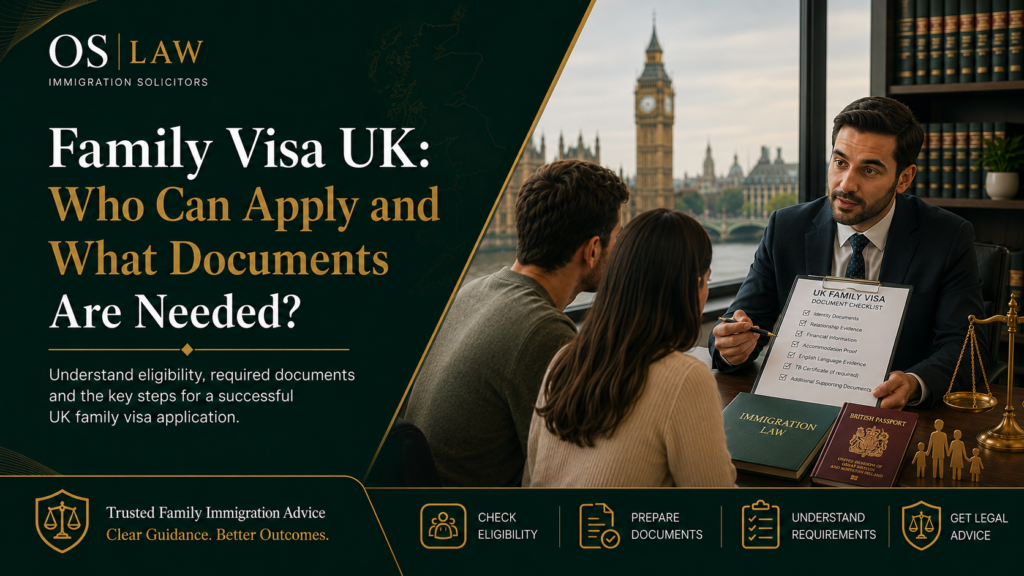
Being separated from your husband, wife, partner, child or parent can place enormous pressure on a family.
You may be planning a life together in the United Kingdom. You may already live in the UK but need to protect your right to remain with your family. You may also be worried that a missing document, an income problem or a previous immigration issue could lead to refusal.
A UK family visa can allow an eligible person to join or remain with a close family member in the United Kingdom. However, there is no single family visa that works for every relationship.
The correct route depends on:
- Your relationship with the person in the UK
- Their nationality and immigration status
- Whether you are applying inside or outside the UK
- Your financial circumstances
- Your accommodation
- Your English-language ability
- Whether children are involved
- Your previous immigration history
The application process can appear straightforward online. In practice, the Immigration Rules are detailed and the evidence must be prepared carefully.
A family visa solicitor in the UK can assess the correct route, identify the requirements and help you present a clear application supported by the right evidence.
This guide explains who can apply for a family visa, what documents are normally needed, how the financial and relationship requirements work and what applicants should consider before applying.
Legal update: This guide was reviewed in June 2026. Immigration Rules, fees and Home Office guidance can change. You should check the rules that apply on the date of your application.
Quick Answer: Who Can Apply for a UK Family Visa?
You may be able to apply for a UK family visa to live with your:
- Husband, wife or civil partner
- Unmarried partner
- Fiancé, fiancée or proposed civil partner
- Parent
- Child
- Close relative who will provide long-term care
A person may also be able to apply on the basis of family or private life where removing them from the UK would cause unjustifiably harsh consequences or interfere unlawfully with protected family life.
The precise requirements depend on the route selected. [1]
What Is a UK Family Visa?
A UK family visa is an immigration route that allows an eligible person to live with a qualifying family member in the United Kingdom for more than six months.
The main routes include:
- Spouse or civil partner visa
- Unmarried partner visa
- Fiancé, fiancée or proposed civil partner visa
- Parent visa
- Child visa
- Adult Dependent Relative visa
- Certain applications based on family or private life
Family visas are primarily designed for people joining a British, Irish, settled or otherwise qualifying family member.
They are different from dependant visas.
For example, where the family member in the UK holds a temporary Skilled Worker or Student visa, their partner or child will normally apply as a dependant under that immigration route rather than under the family visa rules. [1]
Which Family Visa Route Should You Choose?
Choosing the correct route is one of the most important parts of the application.
The Home Office will assess the application under the category selected. It will not always redirect an applicant to another route simply because that route might have been more suitable.
Before applying, determine:
- Who your family member is
- Their present immigration status
- Whether you are inside or outside the UK
- Whether you are married, engaged or unmarried
- Whether you live together
- Whether you have dependent children
- Whether you satisfy the financial requirements
- Whether an exception or human-rights argument may apply
An applicant joining a British spouse will usually make a different application from the partner of a Skilled Worker.
Similarly, a parent seeking to remain because of a British child may need to apply under the parent route rather than as a dependant.
A family immigration lawyer can review the full family structure before advising on the correct application.
1. Applying as a Spouse or Civil Partner
You may be able to apply as a spouse or civil partner where both you and your partner are aged 18 or over and your marriage or civil partnership is legally recognised in the UK.
Your partner must normally have a qualifying status, such as:
- British citizenship
- Irish citizenship
- Indefinite leave to remain
- Settled status
- Qualifying pre-settled status
- Protection status
- Certain Turkish Worker or Turkish Businessperson permission
- Qualifying permission as a stateless person
You must generally show that:
- Your relationship is genuine and continuing
- Your marriage or civil partnership is legally valid
- Any previous relationships have permanently ended
- You intend to live together permanently in the UK
- You meet the applicable financial requirement
- You satisfy the English-language requirement
- Suitable accommodation is available
- You do not fall for refusal under the suitability rules
The Home Office does not decide whether a relationship is genuine from the marriage certificate alone.
It may consider how you met, how often you communicate, whether you have lived together, your financial arrangements, previous visits and your future plans.
A well-prepared application should tell the story of the relationship clearly rather than submitting hundreds of unexplained screenshots.
2. Applying as an Unmarried Partner
An unmarried partner may qualify without being married or in a civil partnership.
Applicants commonly assume that they must have lived together continuously for two years. Current guidance is more nuanced.
You may be able to qualify where:
- You have lived together in a relationship similar to marriage or civil partnership for at least two years; or
- You have been in a relationship for at least two years but could not live together because of work, study, cultural restrictions or another genuine reason
Where you have not lived together, the Home Office will expect convincing evidence that the relationship is genuine, durable and continuing.
That evidence may include:
- Regular communication
- Visits to see one another
- Joint travel
- Financial support
- Evidence of shared responsibilities
- Evidence concerning children
- Plans to establish a home together
- Explanations of why cohabitation was not possible
The issue is not simply the number of photographs or messages submitted.
The evidence must demonstrate a committed relationship over the relevant period. [2]
3. Applying as a Fiancé, Fiancée or Proposed Civil Partner
This route is for someone who intends to travel to the UK to marry or enter into a civil partnership with their qualifying partner.
You will normally need to show that:
- Both partners are aged 18 or over
- The relationship is genuine
- You have met in person
- Any previous marriage or civil partnership has ended
- You intend to marry or form a civil partnership within six months
- You intend to live together permanently after the ceremony
- The financial, accommodation and English requirements are met
A fiancé or proposed civil partner visa is normally granted for six months.
The applicant cannot normally work or study during this period.
After the marriage or civil partnership takes place, the applicant must make a further application as a spouse or civil partner. The right to work normally begins only after that further application is approved. [2]
Fiancé visa or Marriage Visitor visa?
These routes serve different purposes.
A fiancé visa is generally suitable where the applicant plans to marry in the UK and then remain here with their partner.
A Marriage Visitor visa is generally intended for someone who will marry or form a civil partnership in the UK but leave the UK afterwards.
Applying under the wrong route can create serious problems.
4. Applying as a Parent
A person may apply for a family visa to care for their child in the UK.
However, where the applicant is eligible to apply as a partner, the Home Office generally expects them to use the partner route rather than the parent route.
For the parent route, the child must normally:
- Be under 18 on the application date, or have been under 18 when the applicant was first granted permission under the route
- Live in the UK
- Not be married or in a civil partnership
- Be British or Irish, settled, hold qualifying pre-settled status or, in some in-country cases, have lived in the UK continuously for at least seven years
The applicant must normally have sole or shared parental responsibility.
Where the child lives with another parent or carer, the applicant may need to prove that they have direct access to the child and play an active role in the child’s upbringing.
Strong evidence can include:
- School letters
- Medical letters
- Health visitor records
- Local authority correspondence
- Court orders
- Contact arrangements
- Evidence of day-to-day care
- Evidence of involvement in education and health decisions
Photographs, greetings cards and messages may provide background, but official evidence from schools, courts, healthcare professionals or public authorities is usually more persuasive.
The applicant must also normally show that they can maintain and accommodate themselves and any dependants without relying on public funds. [5]
5. Applying as a Child
A child may be able to apply to join or remain with a parent in the UK.
The requirements depend on:
- Whether the child was born inside or outside the UK
- The child’s age
- The status of each parent
- Whether the parents are applying together
- Whether one parent has sole parental responsibility
- Whether there are serious and compelling family considerations
- Whether the child is already on a family route
A child will generally need to:
- Live with the relevant parent, unless living away temporarily for full-time education
- Be unmarried and not in a civil partnership
- Remain dependent on the parent
- Have suitable care and accommodation arrangements
Where the child is aged 18 or over, the route becomes more restricted.
An adult child may generally continue as a dependant only where they were originally granted family-route permission while under 18 and have not formed an independent family life.
Typical documents include:
- Full birth certificate
- Passport
- Evidence of the parent’s status
- Evidence showing where the child lives
- School or university letters
- Evidence of financial dependency
- Consent from the other parent where relevant
- Court orders or parental responsibility evidence
- Evidence explaining any exceptional care arrangements
Child applications can become particularly complex where only one parent is moving to the UK or where the child’s other parent remains overseas. [6]
6. Applying as an Adult Dependent Relative
The Adult Dependent Relative route is intended for adults who need long-term personal care from a close relative living permanently in the UK.
The applicant must normally be a:
- Parent
- Grandparent
- Son
- Daughter
- Brother
- Sister
They must generally demonstrate that:
- They are aged 18 or over
- They require long-term personal care because of age, illness or disability
- They cannot perform everyday personal or household tasks without that care
- The required care is unavailable or unaffordable in their country of residence
- Their relative in the UK can provide suitable care, maintenance and accommodation
- The required support can be provided without relying on public funds
This is a demanding route.
It is not enough to show that the applicant would prefer to live with family in the UK or that care would be better here.
The evidence may need to address:
- The applicant’s medical condition
- Their daily care needs
- Existing care arrangements
- Available carers in their home country
- The cost of suitable care
- Why family members or professional carers cannot provide it
- The UK sponsor’s accommodation
- The UK sponsor’s finances
- A detailed future care plan
An initial Adult Dependent Relative application must normally be made from outside the UK, except where the applicant is already extending permission under the route. [7]
7. Applications Based on Family Life or Human Rights
Some applicants cannot meet every standard requirement of the five-year family route.
That does not always mean that no application is possible.
A person may have a potential application based on family life or exceptional circumstances where refusal would cause unjustifiably harsh consequences or breach protected human rights.
Relevant circumstances may include:
- A British child
- A child who has lived in the UK continuously for seven years
- Serious medical issues
- Domestic abuse
- Significant caring responsibilities
- An inability to continue family life outside the UK
- A partner or child who cannot reasonably relocate
- Exceptional dependency between family members
These cases require more than a statement that separation would be difficult.
The evidence should explain exactly:
- Who would be affected
- How they would be affected
- Why relocation is not realistic
- Why family life cannot continue through visits or communication
- What impact refusal would have on any children
- Whether medical, educational or safeguarding concerns exist
An application relying on exceptional circumstances may place the applicant on a longer route to settlement.
It should be prepared with careful reference to the relevant Immigration Rules and human-rights principles. [10]
Who Cannot Normally Apply for a Family Visa?
A family visa may not be the correct route where:
- The family member in the UK holds a temporary work visa
- The family member in the UK holds a Student visa
- The applicant only intends to visit for six months or less
- The applicant is visiting solely to marry and then leave
- The applicant may qualify under the EU Settlement Scheme
- The relationship does not fall within a recognised family category
- The applicant is seeking to join an extended relative without long-term care needs
A partner or child joining a temporary worker or student may need to apply as a dependant under that person’s visa route.
A person visiting relatives temporarily may need a Standard Visitor visa.
Using the wrong route may result in refusal and the loss of substantial application fees.
What Are the Main UK Family Visa Requirements?
Although each route is different, many applications are assessed against the following areas:
Relationship requirement
You must prove that the relevant family relationship exists and meets the legal definition for the route.
Sponsor status
The family member in the UK must hold a qualifying nationality or immigration status.
Financial requirement
You may need to satisfy a minimum income requirement or demonstrate adequate maintenance.
Accommodation requirement
There must normally be suitable accommodation for the family without overcrowding or prohibited reliance on public funds.
English-language requirement
Partners and parents may need to demonstrate English-language ability unless an exemption applies.
Suitability requirement
Criminality, deception, immigration breaches, false documents or unpaid litigation costs may affect the application.
Immigration status requirement
Applicants applying inside the UK must consider whether switching is permitted from their present category.
Genuine intention
Partners must normally intend to live together permanently. Parents must intend to continue taking an active role in their child’s upbringing.
What Documents Are Needed for a UK Family Visa?
There is no universal family visa document checklist.
The required documents depend on the application route and the applicant’s circumstances.
However, most applications will require evidence in several core categories. [4]
1. Identity and Immigration Documents
You may need to provide:
- Current passport or valid travel document
- Copies of previous passports
- Passport pages showing visas and entry stamps
- eVisa details or a UKVI share code
- Existing or previous biometric residence permit
- Previous Home Office decision letters
- Details of previous UK immigration applications
- Details of visa refusals in the UK or elsewhere
- National Insurance number, where applicable
- Biometric information
Make sure that names, dates of birth and passport details are consistent across every document.
Differences in spelling or transliteration should be explained.
2. Sponsor’s Status Documents
The family member in the UK may need to provide:
- British or Irish passport
- Certificate of naturalisation or registration
- Evidence of indefinite leave to remain
- Evidence of settled or pre-settled status
- UKVI share code
- Evidence of protection status
- Current immigration decision letter
- Proof of permanent residence where relevant
The evidence should clearly establish that the sponsor is permitted to support the family visa application.
3. Relationship Documents
For a spouse or civil partner application, evidence may include:
- Marriage certificate
- Civil partnership certificate
- Divorce certificates from previous marriages
- Death certificate of a former spouse
- Documents showing that the ceremony is legally recognised
- Evidence of cohabitation
- Joint financial records
- Correspondence addressed to both partners
- Evidence of regular contact
- Travel records
- Photographs covering the relationship
- Statements explaining how the relationship developed
For an unmarried partner application, the evidence should demonstrate a durable relationship over the relevant period.
Where the couple has not lived together, the application should explain why and provide alternative evidence of commitment.
4. Evidence of Cohabitation
Useful documents may include:
- Tenancy agreements
- Mortgage statements
- Council Tax bills
- Utility bills
- Joint bank statements
- Individual bank statements sent to the same address
- HMRC letters
- NHS or GP letters
- Driving licence records
- Insurance documents
- Employer correspondence
- Electoral register evidence
Documents should cover the relevant period rather than being concentrated in one or two months.
Where bills are not in joint names, separate documents addressed to each partner at the same address may still help demonstrate cohabitation.
5. Financial Documents
The required financial documents depend on the income source relied upon.
An employed sponsor may commonly need:
- Payslips
- Personal bank statements showing salary payments
- Employer letter
- Employment contract
- P60, where relevant
The employer letter should normally confirm:
- Employment
- Job title
- Length of employment
- Type of contract
- Gross salary
- How long the current salary has been paid
- That the payslips are genuine
Self-employed applicants, company directors and people relying on dividends face more detailed evidential rules.
They may need tax returns, business accounts, company records, accountant evidence, bank statements and proof that tax obligations have been met.
Pension income, rental income, investment income and cash savings require their own evidence.
Do not assume that one bank statement or a letter from an accountant will be sufficient.
6. Accommodation Documents
Applicants may need to establish that suitable accommodation is available without unlawful overcrowding.
Documents may include:
- Tenancy agreement
- Landlord consent letter
- Mortgage statement
- Land Registry title
- Council Tax bill
- Property inspection report
- Letter from the property owner
- Evidence of the number of rooms and occupants
- Evidence of housing costs
Where the couple will live with relatives, the application should explain:
- Who owns or rents the property
- Who currently lives there
- How many bedrooms are available
- Whether the applicant has permission to live there
- Whether the accommodation will remain suitable after arrival
7. English-Language Documents
Partners and parents may need to prove English-language ability.
This may be demonstrated through:
- An approved Secure English Language Test
- A qualifying UK degree
- An eligible overseas degree taught in English with the required assessment
- Nationality from an exempt majority English-speaking country
- A qualifying age or medical exemption
For an initial partner or parent application, the required test is normally at least CEFR level A1 in speaking and listening.
A higher level may be required at extension or settlement.
Children, Adult Dependent Relatives, applicants aged over 65 and people with a qualifying physical or mental condition may be exempt. [8]
8. Tuberculosis Test Certificate
An applicant applying from certain countries may need a tuberculosis test certificate.
The test usually needs to be completed at a clinic approved for UK immigration purposes.
Whether the certificate is required depends on:
- The applicant’s country of residence
- How long they have lived there
- The length and type of visa requested
- Any applicable exemption
The certificate should remain valid on the application date.
9. Certified Translations
Documents that are not in English or Welsh generally need an appropriate translation.
The translation should normally identify:
- The translator
- The translator’s contact details
- The date of translation
- Confirmation that the translation is accurate
- The translator’s signature or professional credentials
Do not submit informal translations prepared by friends or relatives where a certified translation is required.
10. Documents for Children
A child application may require:
- Full birth certificate
- Current passport
- Parent’s passport and immigration status
- School records
- Medical records
- Evidence of address
- Evidence of dependency
- Consent from the other parent
- Court orders
- Evidence of sole parental responsibility
- Evidence of serious and compelling circumstances
- Care arrangements in the UK
Where one parent remains overseas, the Home Office may closely examine who has parental responsibility and why the child should relocate.
11. Documents for a Parent Application
A parent applying on the basis of a child may need:
- Child’s full birth certificate
- Child’s British or Irish passport
- Evidence of the child’s settled or pre-settled status
- School letters
- Medical or dental letters
- Evidence of contact
- Court orders
- Parental agreements
- Evidence of financial support
- Evidence that the parent attends appointments or school events
- Evidence of the child’s residence in the UK
The evidence should demonstrate active parenting rather than occasional contact.
What Is the Financial Requirement for a Partner Visa?
For most new partner applications, the applicant and partner must usually demonstrate a combined annual income of at least £29,000.
Different rules may apply where:
- The first successful partner-route application was made before 11 April 2024
- The sponsor receives specified disability or carer-related benefits
- The applicant relies on exceptional circumstances
- Cash savings or non-employment income are used
- The sponsor is returning to the UK from overseas
- The applicant is self-employed or a company director
Applicants extending with the same partner after first applying before 11 April 2024 may remain subject to the previous £18,600 threshold, with transitional child additions where applicable.
Where the sponsor receives specified benefits, the fixed minimum-income threshold may not apply. The family may instead need to demonstrate adequate maintenance and accommodation.
The date of the first relevant application can therefore significantly affect the requirement. [3]
What Income Can Be Used?
Depending on the circumstances, qualifying sources may include:
- UK employment income
- UK self-employment income
- Director income
- Pension income
- Property rental income
- Dividends
- Certain non-employment income
- Cash savings above the applicable starting level
The rules determine:
- Whose income can be used
- Whether overseas income can be counted
- How long the income must have been received
- Which documents must be supplied
- Whether different sources can be combined
- How cash savings are calculated
An application can be refused even where the family earns enough if the required evidence is missing or does not cover the correct period.
Do Family Visa Applicants Need Accommodation?
Yes, most family visa applications require evidence that adequate accommodation will be available.
The property should normally:
- Be legally occupied
- Have enough space for the household
- Not be statutorily overcrowded
- Be available to the applicant
- Not require prohibited additional access to public funds
Applicants do not necessarily need to own a home.
Rented accommodation or living with relatives may be acceptable where the arrangements are genuine, permitted and suitable.
Can You Switch to a Family Visa From Inside the UK?
Some applicants can switch to a family visa while already in the UK.
However, a person will usually need to leave the UK and apply from overseas where they:
- Are in the UK as a visitor
- Have permission for six months or less
- Hold a category from which switching is not permitted
Important exceptions may apply, including certain fiancé visa holders and cases involving family court proceedings or human-rights considerations.
Do not assume that marriage to a British citizen automatically permits an in-country switch.
The applicant’s existing immigration category must be checked first. [1]
How to Apply for a UK Family Visa
The general process involves the following stages.
Step 1: Identify the correct route
Confirm whether the application is as a partner, parent, child, fiancé or Adult Dependent Relative.
Step 2: Check the sponsor’s status
Confirm the sponsor’s nationality, settlement status or immigration permission.
Step 3: Review every requirement
Check relationship, financial, accommodation, English, immigration-status and suitability requirements.
Step 4: Prepare the evidence
Create a document checklist based on the specific route and financial category.
Step 5: Complete the online application
Answer every question carefully and consistently with previous immigration applications.
Step 6: Pay the applicable charges
This may include the visa fee, Immigration Health Surcharge and optional priority-service charges.
Step 7: Prove identity and provide biometrics
The applicant may need to attend an appointment or use a digital identity process.
Step 8: Upload supporting documents
Documents should be readable, complete and organised logically.
Step 9: Respond to any Home Office request
The Home Office may request further documents or invite the applicant to an interview.
Step 10: Receive the decision
Successful applicants will normally receive digital evidence of status through an eVisa or UKVI account.
How Much Does a UK Family Visa Cost?
As of June 2026, the main application fee for joining a partner, parent or child is:
- £2,064 when applying outside the UK
- £1,407 when applying inside the UK
Each dependant normally pays a separate application fee.
The Immigration Health Surcharge is usually payable in addition to the application fee. The total depends on the applicant’s age and length of permission.
Adult Dependent Relative application fees differ and can be substantially higher for applications made outside the UK.
Fees change periodically, so the current amount should always be checked immediately before submission. [1]
How Long Does a Family Visa Take?
Current standard processing times vary by route and where the application is submitted.
Applications made outside the UK as a partner, parent, child or Adult Dependent Relative are generally listed with a standard processing time of around 12 weeks.
For applications made inside the UK:
- A standard partner application meeting the usual requirements may take around eight weeks
- A child application may take around eight weeks in many cases
- Some parent or human-rights applications can take substantially longer
- Applications relying on exceptions may take around 12 months
Priority or super-priority services may be available for some applications, but availability is not guaranteed.
Applicants should avoid booking non-refundable travel based solely on an estimated processing time. [9]
How Long Can You Stay on a Family Visa?
A partner applying from outside the UK will normally receive permission for two years and nine months.
A partner extending or switching inside the UK will normally receive two years and six months.
A fiancé, fiancée or proposed civil partner is normally granted six months.
Parent-route applicants normally receive:
- Two years and nine months when applying from outside the UK
- Two years and six months when extending or switching inside the UK
The period granted may differ where the applicant is placed on a ten-year route or succeeds on exceptional circumstances.
Can a Family Visa Lead to Indefinite Leave to Remain?
Yes, many family visa routes can lead to settlement.
A partner or parent on the standard five-year route may normally apply for Indefinite Leave to Remain after completing five continuous years under the relevant route.
Time spent as a fiancé does not normally count towards the five-year partner settlement period.
Applicants granted permission under exceptional circumstances may be placed on a ten-year route.
Settlement has its own requirements, which may include:
- Continuous residence
- Continuing relationship or parental responsibility
- Financial requirements
- English-language ability
- Life in the UK Test
- Suitability requirements
- Valid immigration status
Applicants should confirm which route they are on by reviewing their Home Office decision letter.
Common Reasons UK Family Visas Are Refused
Family visa applications may be refused because:
- The wrong visa route was selected
- The relationship evidence was insufficient
- Financial documents did not meet the specified rules
- Income was below the required threshold
- Payslips and bank statements did not match
- The accommodation evidence was incomplete
- The English-language evidence was invalid
- A previous marriage had not legally ended
- The applicant tried to switch from a prohibited category
- Parental responsibility was not proven
- The evidence did not show an active role in a child’s life
- An Adult Dependent Relative did not meet the strict care test
- Criminal history or immigration breaches were not disclosed
- False or inconsistent information was provided
- Required translations or TB evidence were missing
A refusal does not always mean that the relationship is doubted.
Sometimes the applicant meets the underlying requirement but has not submitted the precise evidence required by the Immigration Rules.
How Can a Family Visa Solicitor in the UK Help?
A family visa solicitor in the UK can help by:
- Identifying the correct immigration route
- Reviewing the sponsor’s status
- Checking whether an in-country application is permitted
- Assessing the financial requirement
- Identifying the correct financial evidence category
- Reviewing relationship documents
- Preparing a tailored document checklist
- Drafting legal representations
- Addressing previous refusals or immigration breaches
- Explaining inconsistencies
- Preparing human-rights submissions
- Reviewing the final application before submission
- Advising on a refusal, appeal or fresh application
Professional advice is especially valuable where:
- The sponsor is self-employed
- Income comes from several sources
- Cash savings are being relied upon
- The couple has not lived together
- A previous visa was refused
- One parent remains overseas
- The applicant has overstayed
- Criminal convictions exist
- The applicant cannot meet a standard requirement
- Human-rights or exceptional circumstances are involved
The purpose of legal advice is not simply to upload more documents.
It is to ensure that every document helps prove a particular legal requirement.
UK Family Visa Document Checklist
Before submitting the application, check that you have considered:
Applicant documents
- Passport and previous passports
- Immigration history
- eVisa or BRP evidence
- Previous refusal letters
- TB certificate where required
- English-language evidence
- Certified translations
- Criminal-history information
Sponsor documents
- Passport
- Immigration-status evidence
- Proof of UK address
- Employment or income evidence
- Accommodation evidence
Relationship documents
- Marriage or civil partnership certificate
- Divorce or death certificates
- Cohabitation evidence
- Communication records
- Visit and travel evidence
- Joint financial records
- Relationship statement
Financial documents
- Payslips
- Bank statements
- Employer letter
- Employment contract
- Tax and business records
- Pension documents
- Savings evidence
- Non-employment income evidence
Child or parent documents
- Birth certificates
- School letters
- Medical letters
- Court documents
- Parental consent
- Evidence of parental responsibility
- Evidence of active involvement
This checklist is a starting point, not a substitute for route-specific legal analysis.
Frequently Asked Questions About UK Family Visas
Who is eligible for a UK family visa?
Eligibility may extend to spouses, civil partners, unmarried partners, fiancés, parents, children and certain adult relatives requiring long-term care. The family member in the UK must hold an eligible nationality or immigration status.
How much income is needed for a spouse visa?
Most new partner applications require combined annual income of at least £29,000. Transitional rules may apply where the applicant first entered the partner route before 11 April 2024.
Can I use savings instead of employment income?
Cash savings may be used in some partner applications, either alone or combined with qualifying income. The savings must meet the calculation and evidential requirements.
Do I need to have lived with my partner for two years?
Not always. An unmarried couple may qualify where they have been in a relationship for at least two years but could not live together for a genuine reason, such as work, study or cultural restrictions.
Can I apply for a family visa while visiting the UK?
Visitors will usually need to leave the UK and apply from overseas. Limited exceptions and human-rights considerations may apply.
Can I work on a UK family visa?
Partners, spouses and many parent-route applicants can normally work once their family visa is granted. A fiancé or proposed civil partner cannot normally work while holding the initial six-month permission.
Does a family visa lead to British citizenship?
A family visa may lead to Indefinite Leave to Remain. British citizenship is a separate application with its own residence, status, character, English and Life in the UK requirements.
Can my child apply with me?
A child may be included or apply separately where the relevant dependency, relationship and care requirements are met.
What happens if I do not meet the £29,000 requirement?
You may be able to rely on savings, other permitted income sources, an adequate-maintenance exception or exceptional circumstances, depending on your case. Not meeting the standard requirement does not automatically mean that no application is possible.
Can a family visa be refused because of missing documents?
Yes. The applicant is responsible for proving that every requirement is met. The Home Office is not required to request every missing document before deciding the application.
Do I need a family immigration lawyer?
A lawyer is not legally required. However, advice can be valuable where the finances, relationship history, immigration status or family circumstances are complicated.
Speak to a Family Immigration Lawyer at OS LAW
A family visa application is about far more than completing an online form.
It is about protecting your ability to live with the people who matter most.
The application must connect your circumstances to the Immigration Rules and support every requirement with clear, consistent evidence.
OS LAW can assess your eligibility, identify the correct family route and help you prepare a properly evidenced application.
Learn more about our UK immigration services or contact OS LAW to arrange a consultation with a family immigration lawyer.
Legal disclaimer: This article provides general information and does not constitute legal advice. Immigration Rules, fees and Home Office policies change regularly. Advice should be obtained for your individual circumstances before making an application.