
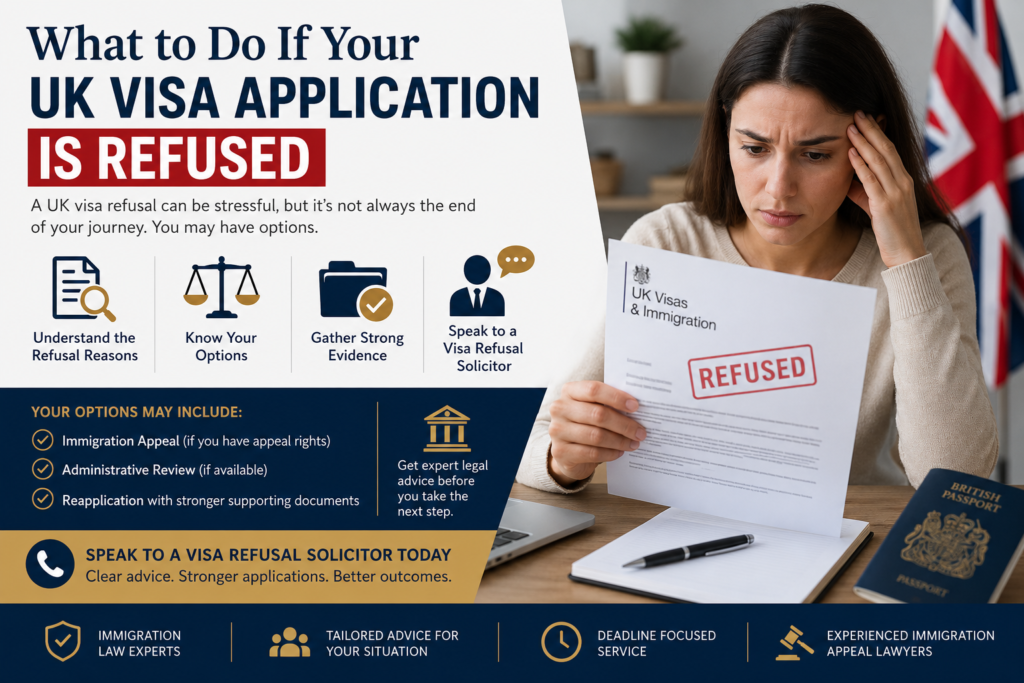
A UK visa refusal can feel overwhelming. You may be worried about your future, your family, your job, your studies, or your right to stay in the UK.
But a refusal does not always mean the end of the process.
The right next step depends on several things: the visa category, the reasons given in the Home Office refusal letter, the evidence you submitted, whether UKVI made an error, and whether you have appeal rights, administrative review rights, or the option to reapply.
This is where speaking to a visa refusal solicitor can make a real difference. Not because every refusal can be overturned, but because the wrong response can make things worse.
What should you do if your UK visa application is refused?
If your UK visa application is refused, read the refusal letter carefully, identify the reasons for refusal, check whether you have appeal rights or administrative review rights, gather evidence addressing the issues, and speak to a visa refusal solicitor before appealing, requesting a review, or submitting a new application.
What does a UK visa refusal mean?
A UK visa refusal means UKVI or the Home Office has decided that your application does not meet the relevant immigration rules, evidential requirements, suitability requirements, or eligibility criteria.
It does not always mean you can never get a UK visa.
In many cases, refusals happen because of:
- Missing supporting documents
- Weak financial evidence
- Inconsistent information
- Relationship evidence concerns
- Sponsorship problems
- Credibility concerns
- Previous immigration history
- Caseworker misunderstanding or error
Your refusal decision should explain why the application was refused and whether you can appeal or request an administrative review. GOV.UK explains that appeal rights and administrative review options depend on the type of decision and what your decision letter says.
Why are UK visa applications refused?
Visa applications are usually refused because UKVI believes the applicant has not met the rules or has not provided enough reliable evidence.
For example, a spouse visa refusal may happen because the Home Office is not satisfied that the relationship is genuine, the financial requirement is met, or suitable accommodation is available.
A visitor visa refusal may happen because UKVI is not satisfied that the applicant is a genuine visitor, will leave the UK at the end of the visit, or has enough financial ties to their home country.
A student visa refusal may involve credibility concerns, financial evidence problems, or issues with the Confirmation of Acceptance for Studies.
A skilled worker visa refusal may involve sponsorship, salary, role, certificate of sponsorship, or eligibility issues.
The most important point is this: you should not guess. You need to understand the exact visa refusal reasons before deciding what to do next.
What should you do immediately after a visa refusal?
Do not rush into submitting another application the next day.
A quick reapplication may feel productive, but if it repeats the same mistakes, it may lead to another refusal.
Here is the safer approach.
1. Stay calm and do not rush into a new application
A refusal is stressful, but panic can lead to poor decisions. Before you reapply after visa refusal, you need to know why the application failed.
Common mistake: submitting the same documents again and hoping for a different result.
2. Read the Home Office refusal letter carefully
Your Home Office refusal letter is the starting point. It should explain the refusal decision, the rules relied on, and whether you have appeal or administrative review options.
Look for:
- The date of decision
- The visa category
- The immigration rules mentioned
- The factual reasons for refusal
- Any missing documents
- Any credibility concerns
- Any appeal rights or review rights
- Any deadline
3. Identify the exact refusal reasons
Do not only read the headline. Read the reasoning.
For example, “financial requirement not met” could mean the wrong bank statements were provided, the income period was not covered, the sponsor’s employment evidence was incomplete, or the caseworker misunderstood the documents.
4. Check whether you have appeal rights
Not every visa refusal gives a right of appeal. Appeals are commonly linked to human rights, protection, and certain family-related cases. GOV.UK states that the First-tier Tribunal can hear certain immigration and asylum appeals, and that the tribunal is independent of government.
Common mistake: assuming every refusal can be appealed.
5. Check whether administrative review is available
Administrative review may be available where the issue is a caseworking error in an eligible application. For applications made outside the UK, GOV.UK says the decision letter will tell you whether you can request administrative review, and the usual deadline is 28 days from receiving the decision.
For in-country administrative review, the Home Office guidance refers to 14 calendar days for permission to stay refusals where the person is not detained.
6. Decide whether to appeal, request review, or reapply
This is the key decision.
The best option depends on the refusal reason, evidence, deadlines, visa type, and whether there was a legal or factual error.
7. Gather stronger supporting evidence
If the refusal was caused by missing or weak evidence, you may need better documents.
This may include updated bank statements, employer letters, relationship evidence, accommodation documents, sponsorship evidence, or explanations for inconsistencies.
8. Fix gaps, inconsistencies, or missing documents
If your previous application had contradictions, deal with them directly. Do not ignore them.
For example, if your application form said one thing and your supporting documents showed another, your next submission should clearly explain the issue.
9. Get advice from a visa refusal solicitor
Speak to a visa refusal solicitor before you reapply, appeal, or request administrative review.
A solicitor can review the refusal letter, assess the evidence, identify the correct route, and help avoid another refusal.
Internal link suggestion: Link the phrase “immigration legal advice” to /immigration/
10. Submit the correct response before the deadline
Deadlines are critical. Some appeal and administrative review deadlines are short. Missing the deadline can seriously affect your options.
How to read your visa refusal letter
Your refusal letter is not just a rejection notice. It is a roadmap.
When reviewing it, ask:
- What exact rule does UKVI say I failed to meet?
- Did UKVI consider all my documents?
- Did I provide the correct evidence?
- Has the caseworker misunderstood anything?
- Do I have appeal rights?
- Can I request administrative review?
- Is a fresh application better?
- What is the deadline?
Do not rely only on the first paragraph. Many important details appear later in the letter.
Common reasons for UK visa refusal
Here are some of the most common visa refusal reasons.
| Refusal Reason | What It Usually Means |
|---|---|
| Missing documents | Required evidence was not provided or was incomplete |
| Financial concerns | Income, savings, maintenance, or bank evidence did not meet the rules |
| Relationship concerns | UKVI was not satisfied the relationship was genuine or continuing |
| Credibility concerns | UKVI doubted the purpose of travel, study, work, or stay |
| Sponsorship issues | Sponsor licence, CoS, CAS, employment, or support evidence had problems |
| Accommodation issues | Evidence did not show suitable accommodation |
| Immigration history | Previous refusals, overstaying, deception concerns, or breaches affected the decision |
| Inconsistent information | Application form and documents did not match |
| Translation problems | Non-English documents were not properly translated |
| Weak explanation | Important facts were not explained clearly |
Can you appeal a UK visa refusal?
You can only appeal a UK visa refusal if the decision gives you a right of appeal.
Appeals are often relevant in human rights cases, family visa refusals, spouse visa refusal cases, protection claims, and certain other immigration decisions. If you have appeal rights, the appeal is usually made to the First-tier Tribunal Immigration and Asylum Chamber.
The tribunal is independent of the Home Office. A judge considers the case and decides whether the refusal should stand or be overturned. GOV.UK explains that if there is no right of appeal, administrative review may be available in some cases instead.
An immigration appeal lawyer can help prepare appeal grounds, evidence, witness statements, legal arguments, and hearing preparation.
Administrative review vs immigration appeal vs reapplication
Choosing the wrong option can waste time and money.
| Option | Best For | What It Means | Risk |
|---|---|---|---|
| Immigration Appeal | Human rights/family cases where appeal rights are given | Challenging the refusal before a tribunal | Can be complex and time-sensitive |
| Administrative Review | Caseworker error in eligible applications | Asking UKVI to review the decision | Not suitable for adding completely new evidence in many cases |
| Reapplication | Refusals caused by missing evidence or weak documents | Submitting a stronger new application | Refusal may happen again if issues are not fixed |
Administrative review is not the same as an appeal. It usually focuses on whether UKVI made a caseworking error. A reapplication is different again because it involves submitting a fresh application, often with improved evidence.
When should you contact a visa refusal solicitor?
You should contact a visa refusal solicitor as soon as possible after receiving the refusal letter.
This is especially important if:
- You have a deadline
- You are in the UK and your immigration status may be affected
- Your family life is involved
- You have a spouse visa refusal or family visa refusal
- You have previous refusals
- UKVI has raised credibility concerns
- The refusal mentions deception or false documents
- You are unsure whether to appeal, review, or reapply
- You need to protect your future immigration record
The earlier you get advice, the more options you may have.
How a visa refusal solicitor can help
A visa refusal solicitor can help by:
- Reviewing your Home Office refusal letter
- Explaining the refusal decision in plain English
- Checking whether the decision is legally or factually flawed
- Advising whether appeal, administrative review, or reapplication is suitable
- Identifying missing or weak supporting documents
- Preparing legal representations
- Helping you avoid repeating mistakes
- Managing deadlines
- Communicating the strongest arguments clearly
A good solicitor will not promise a guaranteed result. Instead, they should give you honest advice about prospects, risks, evidence, costs, and next steps.
What an immigration appeal lawyer does
An immigration appeal lawyer focuses on challenging refusal decisions where appeal rights exist.
They may help with:
- Drafting grounds of appeal
- Preparing witness statements
- Organising evidence bundles
- Addressing Home Office concerns
- Preparing legal submissions
- Representing you at the immigration tribunal
- Explaining the tribunal process
- Advising on possible outcomes
This can be particularly important in spouse visa refusal, family visa refusal, and human rights appeal cases.
Documents you may need after a UK visa refusal
The exact documents depend on your visa category and refusal reason. However, you may need:
- Refusal letter
- Copy of original visa application
- Submitted supporting documents
- Passport
- Previous immigration history
- Financial documents
- Relationship evidence if relevant
- Employment or sponsorship documents if relevant
- Accommodation documents if relevant
- English language evidence if relevant
- Any new evidence addressing the refusal reasons
- Communication with UKVI or Home Office
- Deadline information
- Tribunal or administrative review forms if applicable
Do not assume that more documents automatically means a stronger case. The documents must be relevant, reliable, and directly connected to the refusal reasons.
Common mistakes to avoid after a refusal
A UK visa application refused once can often be improved. But repeated mistakes can damage your position.
Avoid these common errors:
- Reapplying too quickly without fixing the refusal reasons
- Ignoring deadlines
- Sending the same documents again
- Misunderstanding appeal rights
- Choosing administrative review when appeal or reapplication may be more suitable
- Submitting inconsistent information
- Failing to provide certified translations
- Not explaining missing documents
- Ignoring credibility concerns
- Not getting immigration legal advice early enough
The biggest mistake is treating a refusal as a simple paperwork issue when the refusal letter raises deeper concerns.
How to improve your chances after a refusal
You improve your chances by responding to the actual refusal, not the refusal you hoped you had.
That means:
- Read the refusal letter line by line
- Identify every concern raised by UKVI
- Prepare evidence for each issue
- Explain inconsistencies honestly
- Use clear document labels
- Provide translations where required
- Avoid irrelevant evidence
- Keep your facts consistent
- Meet deadlines
- Get professional legal advice before filing
A strong response is focused. It tells UKVI, the Home Office, or the tribunal exactly why the refusal should be reconsidered or why the new application now meets the rules.
Final thoughts
A UK visa refusal is serious, but it is not always final.
You may be able to appeal, request administrative review, or reapply with stronger evidence. The right option depends on the visa category, the refusal reasons, the evidence, the deadline, and your immigration history.
Before taking the next step, speak to a visa refusal solicitor who can review your refusal letter and explain your options clearly.
FAQ Section
What should I do after a UK visa refusal?
Read your refusal letter carefully, identify the reasons for refusal, check your deadline, and get immigration legal advice before appealing, requesting administrative review, or reapplying.
Can I appeal a UK visa refusal?
You can appeal only if your decision gives you appeal rights. Some family, human rights, and protection cases may have appeal rights, but many visitor and work-related refusals may not.
Do I need a visa refusal solicitor?
You are not legally required to use a solicitor, but a visa refusal solicitor can help you understand the refusal, choose the correct option, and avoid repeating mistakes.
What is the difference between an appeal and administrative review?
An appeal challenges the refusal before an independent tribunal. Administrative review asks UKVI to check whether a caseworking error was made in an eligible decision.
Can I reapply after a UK visa refusal?
In many cases, yes. However, you should only reapply after fixing the refusal reasons and strengthening your supporting documents.
Will a UK visa refusal affect future applications?
It can. Future applications usually ask about previous refusals, so you should declare them honestly and explain how the issues have been addressed.
How long do I have to appeal a UK visa refusal?
Deadlines depend on your circumstances and decision letter. Common time limits can be short, often 14 days for some in-country appeals and 28 days for some out-of-country appeals, but you must check your own refusal letter and current rules.
Can an immigration appeal lawyer help me win my case?
An immigration appeal lawyer can help prepare your case properly, but no solicitor can guarantee success. They can assess merits, prepare evidence, and present legal arguments.
What documents do I need after a visa refusal?
You may need your refusal letter, original application, supporting documents, passport, financial evidence, relationship evidence, sponsorship documents, and any new evidence addressing the refusal reasons.
Why was my UK visa refused?
Your refusal letter should explain the reasons. Common reasons include missing evidence, financial issues, credibility concerns, relationship concerns, sponsorship problems, and inconsistent information.
Is administrative review always available?
No. Administrative review is only available for eligible decisions, and your refusal letter should tell you whether you can request it.
Should I appeal or reapply after a spouse visa refusal?
It depends on the refusal reason. If the decision is legally flawed or human rights issues are central, an appeal may be suitable. If documents were missing, reapplication may be better.
A UK visa refusal can be stressful, but the right next step can make a major difference. Before you appeal, request an administrative review, or reapply, speak to a visa refusal solicitor who can review your refusal letter and explain your options clearly.