
Table of Contents
- What the Home Office Expects: The Genuine and Subsisting Relationship Standard
- Creating a Spouse Visa Relationship Evidence Checklist
- Spouse Visa Evidence if Not Living Together
- Spouse Visa Relationship Evidence Examples That Carry Weight
- Building a Relationship Timeline for Your Spouse Visa Application
- Common Mistakes to Avoid When Submitting Relationship Evidence
- Next Steps: Organising and Presenting Your Evidence Effectively
- Frequently Asked Questions
Last Updated: October 14, 2026
What the Home Office Expects: The Genuine and Subsisting Relationship Standard
The Home Office assesses every spouse visa application against one core test: can you prove relationship spouse visa requirements by demonstrating your relationship is genuine and subsisting? This means proving it is real, ongoing, and not entered into primarily to gain immigration advantage.
You must show you live together as a married couple, share financial responsibilities, and that your relationship existed before you applied.
The Home Office doesn’t define exactly what “genuine” looks like; they assess the totality of your circumstances.
The successful applications tell a coherent story that proves your relationship is real rather than just ticking boxes.
Home Office guidance emphasises that evidence should cover the full period of your relationship, from when you first met to the application date. Gaps raise suspicion: if you lived together two years but provide no utility bills from that period, the caseworker will ask why.
Make their assessment straightforward: provide clear, chronological evidence showing how your relationship developed and why you’re now applying.
Creating a Spouse Visa Relationship Evidence Checklist
Building a spouse visa relationship evidence checklist means identifying which documents matter most and gathering them systematically. The Home Office doesn’t require a specific list, but certain categories carry far more weight.
Start with financial evidence. Joint bank accounts, shared mortgage or tenancy agreements, and utility bills in both names are the strongest proof you live together. Multiple bills over several years show sustained cohabitation; if you’ve only recently moved in, even one bill helps establish the timeline.
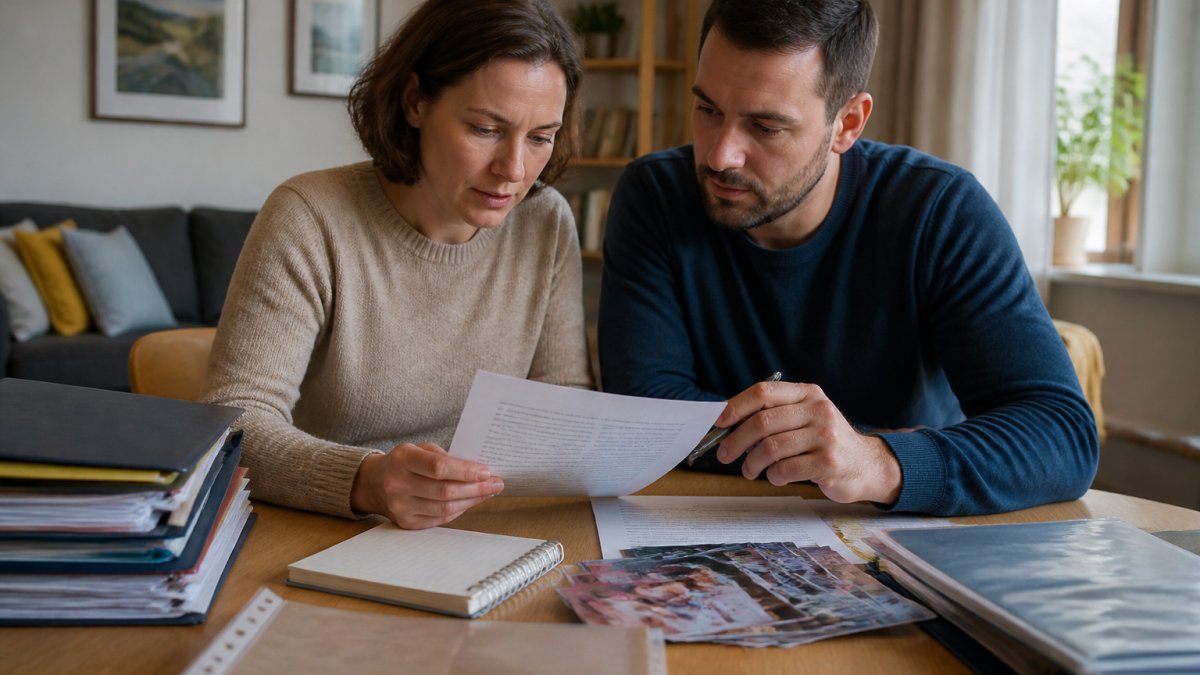
Next, gather relationship history documents. This includes:
- Marriage certificate (the original or certified copy)
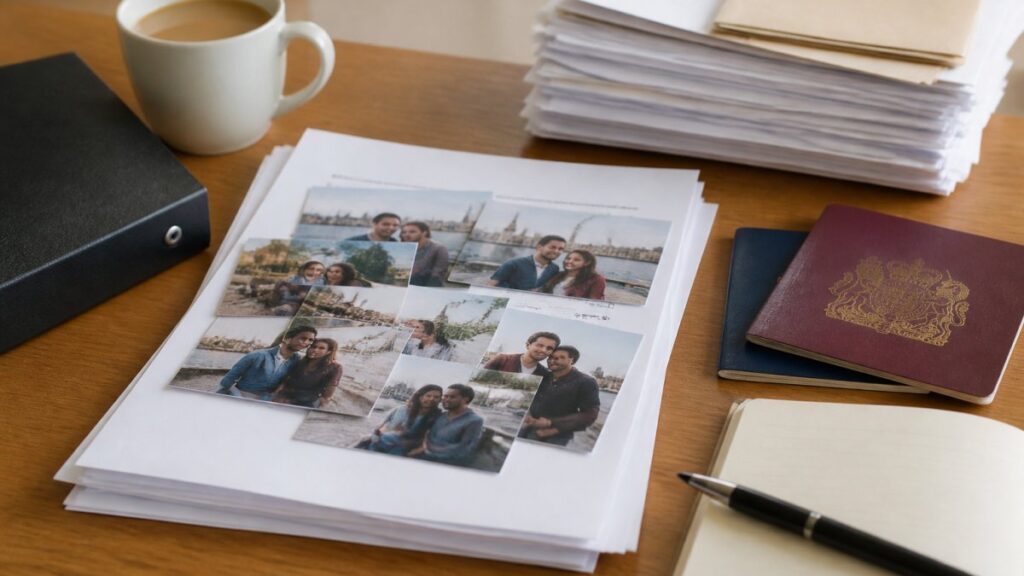
- Photographs together spanning the years of your relationship
- Emails, messages, or letters showing communication
- Travel documents proving you’ve visited each other
- Evidence of joint decision-making (holiday bookings, property searches, medical appointments attended together)
Accommodation evidence matters significantly. If you’ve lived together, collect:
- Tenancy agreements with both names
- Mortgage documents showing joint ownership
- Council tax records listing you both
- Utility bills (gas, electricity, water, internet)
- Council or local authority records confirming your address
Supporting evidence strengthens your application further:
- Children’s birth certificates (if you have children together)
- Joint insurance policies (home, car, pet)
- Evidence of joint savings or investments
- Sponsorship letters from family members
- Evidence of commitment to UK life (job offers, property purchases, school applications for children)
Organise everything chronologically, from when you first met to the application date, so the caseworker can follow your relationship’s development.
Spouse Visa Evidence if Not Living Together
If you and your partner haven’t lived together, your spouse visa relationship evidence is harder to establish. The Home Office scrutinises these applications more carefully because cohabitation is their primary indicator of a genuine, subsisting relationship.
This doesn’t mean your application will fail, but you must work harder to prove your relationship is real.
Frequency of contact becomes crucial. Meeting only twice in three years raises red flags; if you see each other monthly, gather evidence of those visits:
- Flight tickets and boarding passes
- Hotel bookings showing you stayed together
- Photographs from visits
- Receipts from meals or activities you did together
- Messages discussing when you’d next see each other
Communication evidence carries more weight when you haven’t lived together. Collect:
- Emails showing regular, meaningful correspondence
- Messaging app screenshots (WhatsApp, Telegram, Signal)
- Video call logs or records
- Social media messages and interactions
- Phone bills showing regular calls between you
Financial interdependence shows commitment even without cohabitation. Provide evidence that you’re building a life together financially:
- Bank transfers between you (with context, was it for a shared holiday, a gift, or household expenses?)
- Joint savings accounts opened specifically for future plans
- Evidence that one partner has helped the other financially during hardship
- Insurance policies naming each other as beneficiaries
Third-party evidence becomes particularly important. Ask people who know your relationship to write statements, such as:
- Family members who’ve seen you together
- Friends who can attest to the relationship’s reality
- Colleagues who know you’re in a relationship
- Religious leaders or community members who know you both
Keep statements brief, factual and specific. “I’ve known them five years and they’re clearly in love” is weaker than “I’ve attended three holidays with them in 2024 and 2025, and they plan to marry in 2026.”
Spouse Visa Relationship Evidence Examples That Carry Weight
Certain evidence types carry substantially more weight with the Home Office. Understanding which documents matter most helps you prioritise your gathering efforts.
Utility bills are gold standard evidence: issued by independent third parties, hard to fake, and directly proving cohabitation.
Mortgage documents and tenancy agreements carry similar weight. These are legal documents the Home Office can verify with the lender or landlord, proving you’ve jointly committed to a property rather than just visiting.
Children together is powerful evidence of a genuine relationship. Birth certificates prove you’ve built a family unit, and school records, medical records and photographs with children reinforce that your relationship is real and subsisting.
Travel and meeting evidence matters, particularly if you haven’t lived together.
Messages and correspondence carry weight if consistent over time. A single email proves little, but 100 emails spanning three years demonstrate an ongoing relationship.
Third-party statements help but are weaker than documentary evidence.
Financial interdependence proves you’re building a future together. Joint bank accounts, shared savings, or evidence you’ve helped each other financially during hardship all suggest commitment beyond a short-term relationship.
The weakest evidence includes:
- Photographs alone (easy to fabricate or stage)
- Messages without context (could be between anyone)
- Statements from close family (assumed bias)
- Holiday postcards or greeting cards (easily faked)
Building a Relationship Timeline for Your Spouse Visa Application
A relationship timeline for your spouse visa application creates the narrative structure holding your evidence together.
Start by identifying key dates:
- When you first met
- When you first lived together (if applicable)
- When you got engaged or decided to marry
- When you married
- When you moved to the UK (if applicable)
- When you first met the Home Office requirements for a spouse visa
For each major period, identify what evidence you have:
Months 1-6 of relationship: How did you meet? Do you have emails, messages, or photographs from this period? Did you travel to see each other?
Months 6-12: Did your relationship deepen? Did you meet each other’s families? Do you have photographs, travel documents, or messages showing increasing commitment?
Year 1 onwards: When did you move in together? Do you have tenancy agreements, utility bills, or council tax records? When did you decide to marry? Do you have engagement photographs or messages discussing marriage plans?
Around marriage: Collect the marriage certificate and any photographs or documents from the wedding. Include evidence of where you were living at that time.
Post-marriage to application: This period is crucial. The Home Office wants to see your relationship is currently genuine and subsisting, not just that it was genuine at some point. Gather recent evidence:
- Recent utility bills
- Recent photographs together
- Recent messages or correspondence
- Evidence of ongoing shared life (joint appointments, holiday plans, shared financial decisions)
Build the timeline month by month or year by year, noting what evidence you have for each period. If a period has none, consider what you could gather: flight bookings, a council tax certificate, or other records.
The timeline should tell a story that makes sense.
Conversely, if you’ve been together five years, lived together three, and have children, your timeline is straightforward and the evidence will likely speak for itself.
Common Mistakes to Avoid When Submitting Relationship Evidence
Most spouse visa applications fail not because the relationship is fake, but because the evidence is poorly presented. Avoid these common mistakes.
Don’t submit evidence without explanation. The Home Office receives thousands of applications and won’t piece together your story from loose documents.
Don’t rely on photographs alone. They prove you were in the same place at the same time, not that you live together or that your relationship is genuine.
Don’t ignore gaps in your evidence. If you lived together two years but have only one utility bill, the caseworker will notice.
Don’t submit forged or false documents. Submitting a fake utility bill is a criminal offence and will result in refusal and potential prosecution.
Don’t submit documents in other languages without translation. If your marriage certificate is in another language, get it officially translated; the Home Office won’t do it for you.
Don’t submit irrelevant evidence. A stack of 500 documents confuses rather than clarifies. Be selective and include only documents that directly prove your relationship is genuine and subsisting.
Don’t forget recent evidence. The Home Office wants to know your relationship is currently genuine and subsisting.
Next Steps: Organising and Presenting Your Evidence Effectively
Once you’ve gathered your spouse visa relationship evidence, presentation matters. A well-organised application is easier to assess and more likely to succeed.
Create a clear index. List and number every document in order, then reference them by number in your covering letter: “Document 5 is our tenancy agreement from 2023.”
Use a folder structure. Organise documents into categories: financial evidence, accommodation evidence, relationship history, supporting evidence. Within each category, arrange documents chronologically.
Highlight key documents. Use tabs or sticky notes to mark the most important documents. Utility bills, mortgage documents, marriage certificate, and recent photographs should be easy to find.
Provide certified translations. If any documents are in other languages, get them officially translated by a qualified translator.
Check the Home Office requirements. Immigration rules change, so before submitting, check current guidance on spouse visa applications and make sure you meet all requirements (Family visas: apply, extend or switch: Apply as a partner or spouse).
Consider professional help. If you’re uncertain or your circumstances are complex, seek advice from an immigration solicitor.
The difference between a successful and a refused application often comes down to presentation. Scattered, poorly explained evidence looks weak; the same evidence organised clearly and explained thoroughly looks compelling.
Proving your relationship for a spouse visa requires patience and organisation, but the process is straightforward once you understand what the Home Office needs. When you’re ready to move forward, OS LAW can help you prepare an application that presents your relationship persuasively and maximises your chances of approval. Contact us for a consultation on your spouse visa application
Frequently Asked Questions
What documents prove a genuine relationship for a spouse visa?
The Home Office requires evidence showing your relationship is genuine and subsisting. This includes marriage or civil partnership certificates, joint financial documents (bank statements, mortgage or tenancy agreements), photographs spanning the relationship, correspondence between you and your spouse, and witness statements from family or friends. Messages, call logs, and social media interactions also support your case. The strength of your application depends on the volume and consistency of evidence across multiple categories, not just one or two documents.
Can I apply for a spouse visa if we have not lived together?
Yes, you can apply for a spouse visa even if you and your spouse have not lived together, though you will need to provide stronger alternative evidence. Focus on correspondence (emails, letters, messages), travel records showing visits, photographs together, witness statements from people who know you both, and financial transfers between you. The key is demonstrating regular contact, commitment to the relationship, and concrete plans to live together after the visa is granted. Distance alone does not disqualify your application if the evidence shows the relationship is genuine.
How should I organise relationship evidence for a spouse visa application?
Organise your evidence chronologically and by category to make the Home Office’s review straightforward. Create separate sections for documents, photographs, correspondence, and witness statements. Number each item and cross-reference it in a covering letter that explains the significance of key evidence. Provide a brief timeline showing how your relationship developed. Avoid submitting overwhelming quantities of similar items; instead, select representative examples that cover different periods and demonstrate the depth of your relationship. Clear organisation signals to the Home Office that you have taken the application seriously.
What evidence can we provide if we have no joint bills or bank account?
If you lack joint financial documents, strengthen your case with alternative evidence. Use individual bank statements showing transfers between accounts, travel records (flight bookings, hotel reservations) documenting visits, photographs spanning the relationship, messages and call logs, social media posts, witness statements from family and friends, and letters from employers or institutions confirming your relationship status. Correspondence between you and your spouse, such as emails or letters discussing future plans, also carries weight. The Home Office recognises that not all couples share finances, so diverse evidence across other categories can compensate for the absence of joint accounts.